> For the complete documentation index, see [llms.txt](https://docs.glassnode.com/llms.txt). Markdown versions of documentation pages are available by appending `.md` to page URLs; this page is available as [Markdown](https://docs.glassnode.com/further-information/metric-guides/lifespan/median-spent-output-lifespan-msol.md).
# Median Spent Output Lifespan (MSOL)
MSOL (Median Spent Output Lifespan) is the median age (in days) of all spent transaction outputs.
## Indicator Overview
**MSOL (Median Spent Output Lifespan)** is the median lifespan (in days) of all spent transaction outputs.
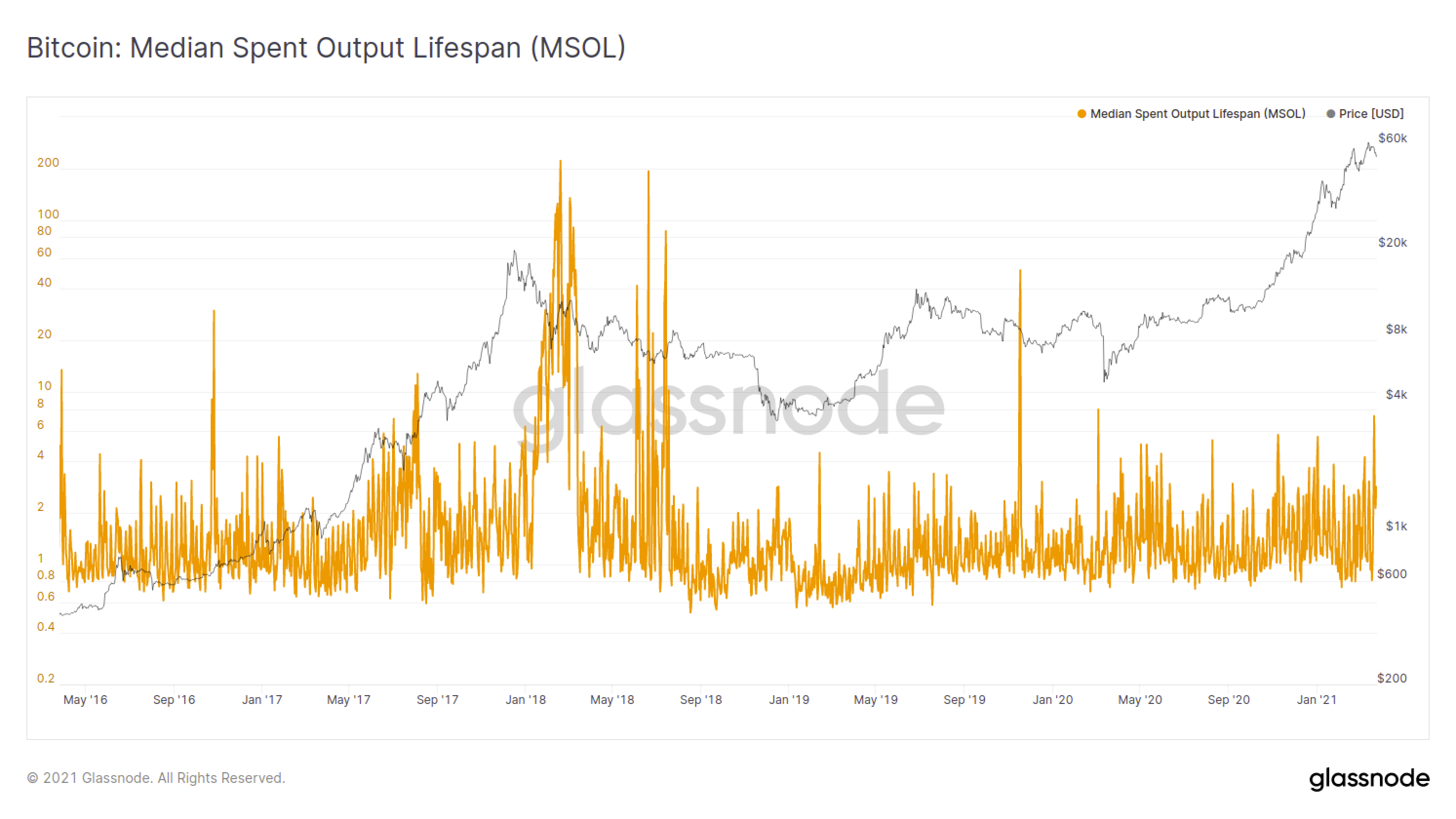
MSOL highlights on a macro level the median lifespan of coins on a per transaction output basis that were spent that day. This provides insight into the balance between short-term (young coins) and long-term (old coins) spending behaviour over a period of time.
Generally speaking, MSOL can be considered in the following framework:
* **MSOL** provides a less sensitive view than [ASOL](/further-information/metric-guides/lifespan/average-spent-output-lifespan-asol.md) and provides insight on the largest cross section of spenders. It deviates less from its baseline (which is dominated by day-to-day traffic, primarily young coins) except during periods of very high volatility where old coins are more likely to be spent.
* **High values** typically indicate an increased proportion of network traffic are old coins being spent, often associated with long term holders taking advantage of high market volatility.
* **Low values** typically indicate day-to-day traffic comprised mainly of young coins being spent, often associated with traders and short term holders.
Note that MSOL account only for the lifespan of the spent outputs and does not consider coin volume moved (i.e. ignores how many BTC units are moved). Two outputs which are 100-days old but worth 0.1BTC and 100BTC respectively, have identical weights in the MSOL calculation.
* [View MSOL in Glassnode Studio](https://studio.glassnode.com/metrics?a=BTC\&m=indicators.Msol)
* [View MSOL in Glassnode API Docs](https://docs.glassnode.com/basic-api/endpoints/indicators#msol)
## How is it measured?
MSOL (Median Spent Output Lifespan) is defined as the median age (in days) of all spent transaction outputs in a given time period.
$$
\textrm{MSOL} = \textrm{Median}\big{ \textrm{lifespan}\~{\color{gray}{\textrm{\[days]}}} \~{\color{gray}{\textrm{(of all spent outputs)}}} \big}
$$
In order to account for [change](/data/utxo-vs.-account-based-chains.md) and eliminate obvious relay transactions, outputs with a lifespan of less than 1 hour are discarded.
## Video Tutorial
{% embed url="" %}
## User Guide
MSOL is an indicator that is best applied as a gauge for changes in older coin spending behaviour from day-to-day baseline traffic. MSOL has few major deviations from its baseline and only experiences notable increases when a larger proportion of the spent outputs had long lifespans. A single old spent output may have limited effect on MSOL, however when a large number of them are spent, the median lifespan is likely to be elevated.
* **High indicator** **values** occur when a large proportion of old coins are on the move, potentially realising profits, taking advantage of market strength, or have reduced conviction to hold the asset.
* **Low indicator values** occur when day-to-day, young coins dominate network traffic, older transaction outputs remain dormant, and conviction to continue holding the asset is high.
### Example Application
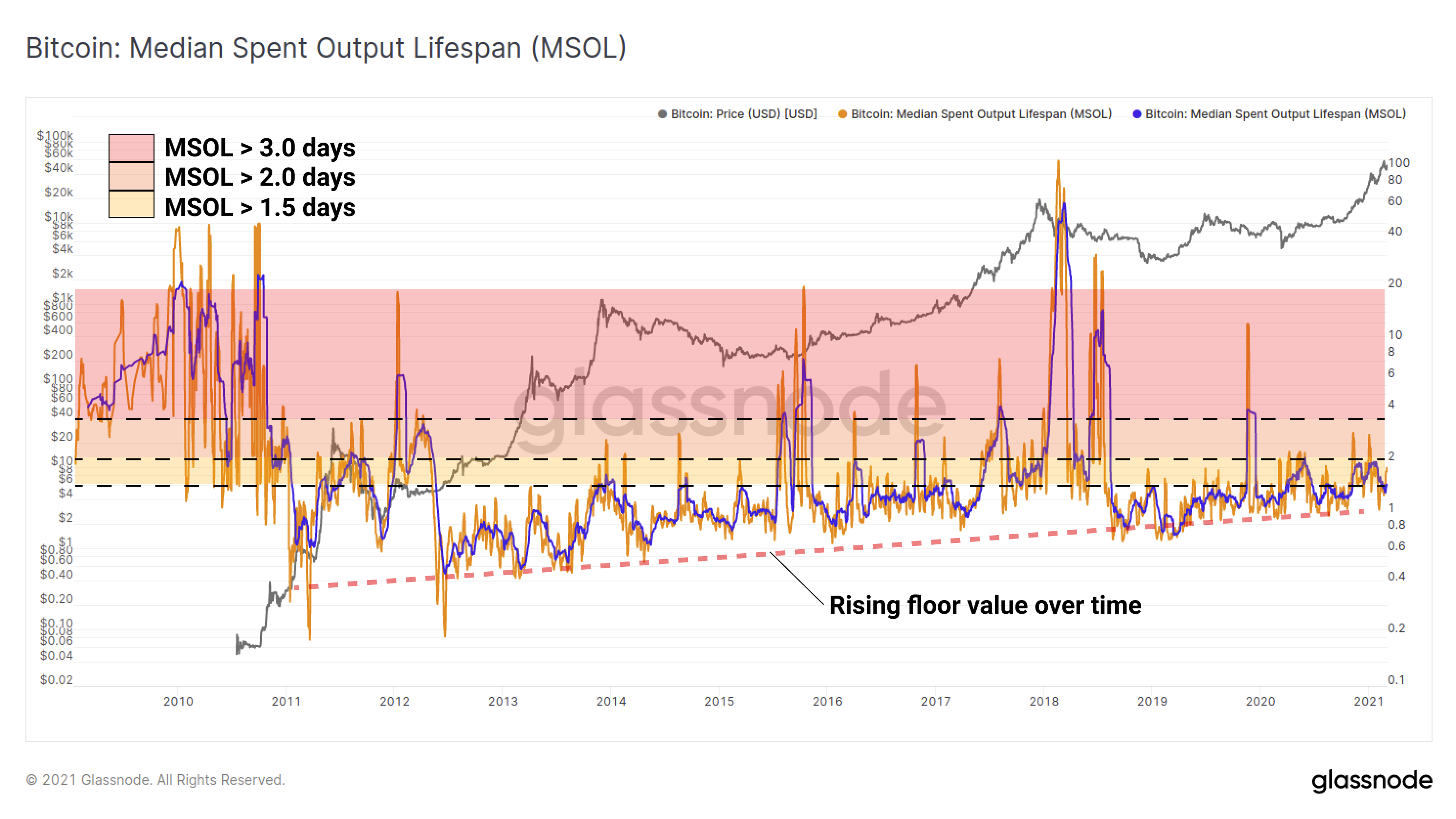
MSOL values are small relative to [ASOL](/further-information/metric-guides/lifespan/average-spent-output-lifespan-asol.md) and does not attain values greater than 1.5 days often, however when it does is usually a relatively large deviations from this baseline. As such MSOL is best viewed on a log scale to put peaks and troughs into context and benefits from application of moving averages with 7-day and 30-day periods recommended.
Peaks in MSOL above 2.0 days tend to occur in periods of high market volatility as a greater proportion of network traffic is comprised of old coins being spent. High MSOL values provide valuable insight on the relative balance of young to old coins, particularly if elevated values persist for long periods of time.
Note also how the lower bound values of the MSOL indicator gradually increases over time. This phenomena is simply a result of there being more aggregate lifespan accumulated by the UTXO set as Bitcoin protocol continues operation.
## About
### Coined By
[Renato Shirakashi](https://twitter.com/renato_shira) (October 2019)
### Further Resources
Glassnode - [ASOL/MSOL Announcement](https://twitter.com/glassnode/status/1177600932420423681)